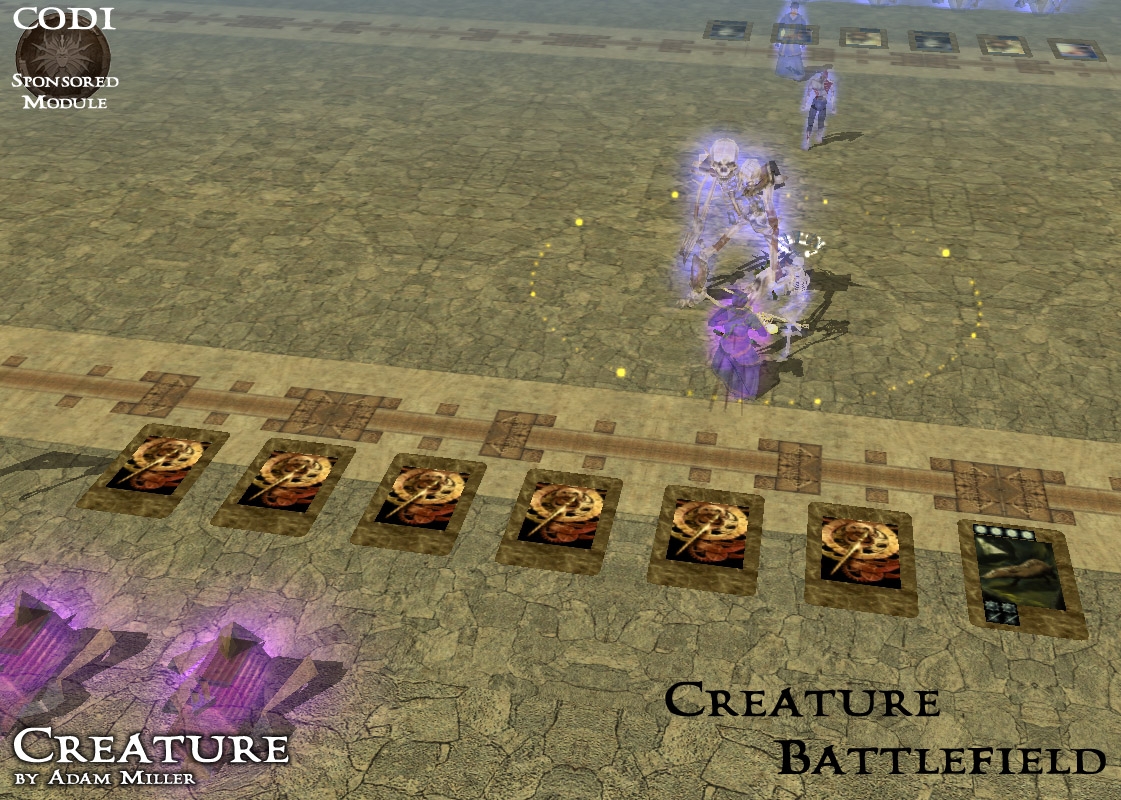
Single and multiplayer support for up to 8 concurrent games.
Language
English
Tricks & Traps
Non-existent
Roleplay
Non-existent
Hack & Slash
Non-existent
Scope
Small
DMNeeded
No DM Required
Single or Multiplayer
Single Player or Multiplayer
Max Character Level
Any
Max # Players
08
Min # Players
01
Min Character Level
Any
Content Rating
Everyone
Description
The Demon Card game is a mini-module from the upcoming Demon module. It is a unique game played in a completely graphical environment, allowing you to pit your deck of cards against computer or human opponents. You can buy and win cards, assemble a deck, then battle it out with your foe. Special thanks to Jazael for his considerable scripting contributions and the CODI team for testing and support. For a quick player's guide, take a look here: http://nwvault.ign.com/modules/tutorials/Adam/
Great Game! I really enjoyed it for several hours in the dreamcatcher campaign and now i wanted to play it with my brother in LAN, but a stupid bug made it a bit complicated. It happens often after a game that my brother (he won) got stuck in the game area and couldn't get back to the "game center". I had to restart the server to continue. That happened every second game or so. (We use servervault if that's important.) Additionaly i have a request: What about enabling playing for jink and cards also in PvP. That would be great. Also saving the Player stats in a database would be nice. And the uber-feature would be to have a persistant ranking. Thanks for your effort! Designing a TCG in NWN was a genious idea!
Posted by KB at 2004-08-0511:29:00
Ahem. I forgot my props preface. This is, bar none, the best mini game (game within a game) that I have seen, in any game thusfar. It's addictive, it's fun, it's nearly as good as playing the PC version of Magic (the original old-school one, not the recent battelgrounds flop) and unbelievably, it runs within another game entirely, overcoming the scripting and engine limitations of that game (NWN). I am in awe that a game this good can be created entierly within another game. There we go, that should just about finish off my 'good game' blurb.
Posted by KB at 2004-08-0511:13:00
I think it's very key NOT to standardize values. Or at least, to broaden the formulas that determine the values of a card. For instance, rarity of the card has to be considered, flexibility in it's use, limitations, etc. THis is one of the prime reasons (imo) that Spellfire (The TSR card game) failed vs Magic the gathering. Magic was very well balanced initially, but there were always those cards that existed as unbalanced, but with limitations not reflected in a first glance of the statistics. For instance, if you add a higher defense to undead than is typical for their cost, they seem unbalanced. Until you release a Spell: Turn Undead. Then the balance is restored again, as undead would still bear unbalanced characteristics, but would bear a heavy vulnerability now, that ofset the advantages of their cost. The trick to successful card games was never to create perfect balance, it was to create so much variety that balance became a matter of ingenuity and prediction, rather than simple formulaic balance. In Magic, extremely unbalanced overpowered decks could be built (generally with a heavy toll on the pocketbook), but there were always enough possibilities and card combinations available to engineer a skillful counter. So far, the Demon game seems o be coming along very well. In the module, I built a flux-based deck, whith the key cards being various heals, flux, scorched earth and many many generators, and was able to clean house on the AI opponents. But, had just one of those AI used a Dispel magic or 2, the entire power of the deck would have been undone. This was an example of good game engineering. Don't build balance into the game. Rather, destroy that balance a million times over, in a million different directions at once. If a few cards prove to be overpowered in one version, then let the next version contain a few counters. Eventually, it will get to the point where there are too many powers and counters to choose from, so that one needs to start playing the odds, guessing which cards his opponent is most likely to use. It puts the human element back into the game. Games with perfect balance, are generally quite boring, as they remove the involved strategy of building consistent success from chaos.





 Site
Site